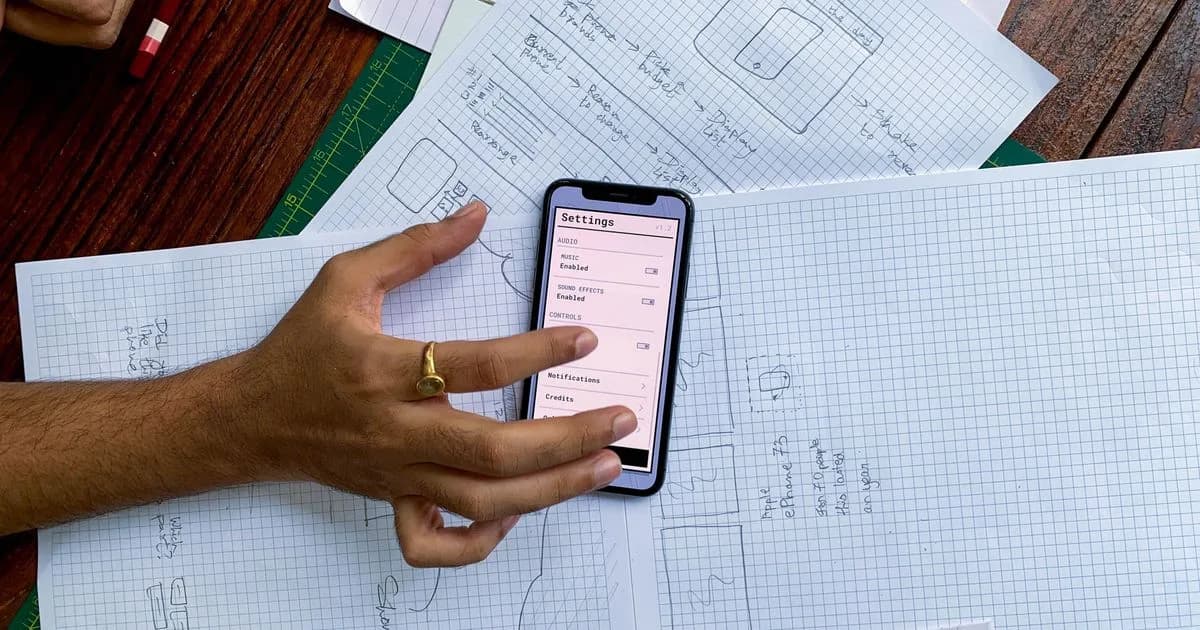
I build mobile apps for businesses in Szczecin and across Poland - remotely, with a fixed price agreed before any code is written. A cross-platform MVP for iOS and Android starts at €6,000. A full product with payments, user accounts and an admin panel runs €12,000-€25,000. From kickoff to App Store and Google Play: 4 to 8 weeks. Real numbers, not the headline figure before the asterisk.
Szczecin is a port city with a large logistics sector, active cross-border trade with Germany, and a growing services market. The apps I build here include mobile panels for transport companies, loyalty systems for restaurants on the Łasztownia waterfront, booking tools for hotels, and B2B tools for companies operating on both sides of the Polish-German border. Each project is different, but the decision framework - scope, tech stack, fixed price before build - is always the same.
What building a mobile app actually involves
A mobile app is not one product. At minimum it's two connected layers with a third on top: the screens on the phone, the backend with a database and API, and the App Store/Google Play submission. Depending on what your Szczecin business needs, that could look like:
- A loyalty app with points, push promotions, and a digital customer card.
- A field worker tool with QR scanning, shipment confirmations, and incident reports - common in Szczecin's port and logistics sector.
- A mobile client sitting on top of an existing order management or inventory system.
- A booking or scheduling app for hospitality, beauty, or fitness businesses.
- A B2B tool that runs in Polish and German from day one, if your teams or clients span both markets.
In every case I deliver: screen design, frontend, backend, external integrations, store submission under your accounts, one month of post-launch support.
Concrete prices and timelines
I quote in EUR per scope, not per hour.
MVP - €6,000-€12,000
Login, the core feature set, one or two integrations, push notifications. Delivered in 4 to 6 weeks. A real product you can put in front of users, not a clickable prototype.
Full product - €12,000-€25,000
Payments (Stripe, Przelewy24, BLIK), user accounts with history, admin dashboard, several integrations. Two to four months. Most serious projects - restaurant chains with delivery, booking platforms with CRM sync, internal tools for logistics teams - land here.
Complex product - from €30,000
Marketplace logic, real-time chat, geolocation, offline sync, complex permission models. These are quoted in phases, not as one number.
For context on what development typically costs across Poland in 2026, see the development cost guide.
React Native vs native - the decision that moves your budget most
React Native gives you one codebase that produces both iOS and Android apps. For 80-90% of business apps, it's the right call. Cost is 30-60% lower than two separate native builds, and there's only one codebase to maintain. It's my default.
Native development - Swift for iOS, Kotlin for Android - means two codebases and roughly double the build and ongoing maintenance cost. Where it earns its price: games, heavy AR, apps driving the camera hard at 60 fps, or deep Bluetooth and sensor work in the background. A logistics company in Szczecin building a shipment-tracking panel with QR scanning and shipment lists does not need native.
Simple question: does your app manage data, orders, accounts, and notifications? React Native. Does it need to extract maximum performance from the GPU or specific hardware sensors? Then native.
How the work goes
It starts with a 30-minute scoping call. You get a written fixed scope and a fixed price - no hourly surprises. Building starts after signing and a deposit. You see weekly progress, not just a handover at the end of six weeks.
The app ships under your developer accounts - Apple Developer ($99 per year, paid directly to Apple) and Google Play ($25 once). After launch I watch App Store Connect and Play Console for 30 days and handle any technical issues that come up.
I work with Szczecin clients remotely. No in-person meeting is needed at any stage. For companies with German-speaking clients or cross-border teams: I build multilingual apps from the start, so you don't need to rebuild later when you decide to expand.
Why a solo senior over a local agency
There's no large mobile agency ecosystem in Szczecin the way Warsaw and Kraków have one. That's actually useful information: you're realistically choosing between a national agency with significant overhead, an unknown freelancer, or a senior developer with a clear track record. A senior who owns the project end-to-end gives you direct accountability without the markup for a PM and account manager you'd rarely talk to anyway.
For the full scope of what I build and how I approach mobile projects, see the mobile app development service page.
Real-world case: a delivery service in Szczecin
A Szczecin delivery service came to me - food and groceries around the city and into the border areas, with some clients and couriers speaking German. Orders came in by phone and WhatsApp, couriers were run through a group chat and a spreadsheet. On busy evenings the whole thing fell apart: orders got lost, the customer had no idea where the courier was, and operators sat on the phone instead of clearing the queue.
What we did. I built two connected apps in React Native from one codebase: a customer app - catalog, order, payment via Przelewy24, delivery status and a push at every stage; and a courier app - order list, accepted/picked-up/delivered buttons, a map and confirmation. Both in Polish and German from the first version, because for border-town Szczecin that isn't optional. On top of that a simple admin panel so operators could see orders and couriers on one screen.
The result: a working MVP came together in six weeks, plus another week to publish to both stores. After launch the share of orders placed without an operator call climbed to about 70%, and the status push took out most of the "where's my order" questions. The German version immediately pulled in cross-border clients who used to fall away on a Polish-only interface.
That's what an app means for Szczecin: not a storefront but a working tool that keeps both customers and couriers in two languages and takes the phone load off peak hours.
FAQ
How much does mobile app development cost in Szczecin? A cross-platform MVP starts at €6,000. A full product with payments, user accounts and an admin panel runs €12,000-€25,000. Complex products with real-time features or marketplace logic start from €30,000. Prices are per fixed scope, not per hour. Szczecin doesn't have a deep local mobile agency market, so most businesses work with remote developers - with no impact on quality or communication.
How long does it take to build a mobile app? A real MVP - deployed to App Store and Google Play - takes 4 to 8 weeks. The first week is scoping and screen design. Then three to five weeks of building. The last week is QA and store submission. Budget an extra week for the App Store: Apple reviews take longer than Google Play and first submissions often come back with small policy issues.
Should I build for iOS and Android separately? Rarely. React Native produces both from a single codebase at 30-60% less than two native builds. It's also cheaper to maintain going forward. Build native separately only when your app genuinely needs platform-specific hardware access at a depth React Native can't reach - games, heavy AR, or specialized sensor work.
Can I work with you from Szczecin remotely? Yes - that's how all my projects run. Scoping call online, fixed quote in writing, weekly updates. No physical meeting required at any stage.
Do you handle App Store and Google Play submission? Yes, that's included. I prepare all store assets, manage the review process, and handle rejections when they happen. The apps are always published under your developer accounts, never mine.
What do I need to have ready before the project starts? A business description of what the app should do - not a technical spec. Your brand assets: logo and colors. Access credentials for systems the app integrates with. Content for the app screens. The last one is the most common cause of delays - when content isn't ready, work stops.
How does payment work? A deposit at kickoff - typically 30-40% - then the remainder by milestone or on final delivery, depending on scope. The price is fixed before the build starts and doesn't change without a scope change.
Ready to get a real number for your project? Get in touch and within a day you'll have a fixed scope and price, not "it depends on a lot of factors."